

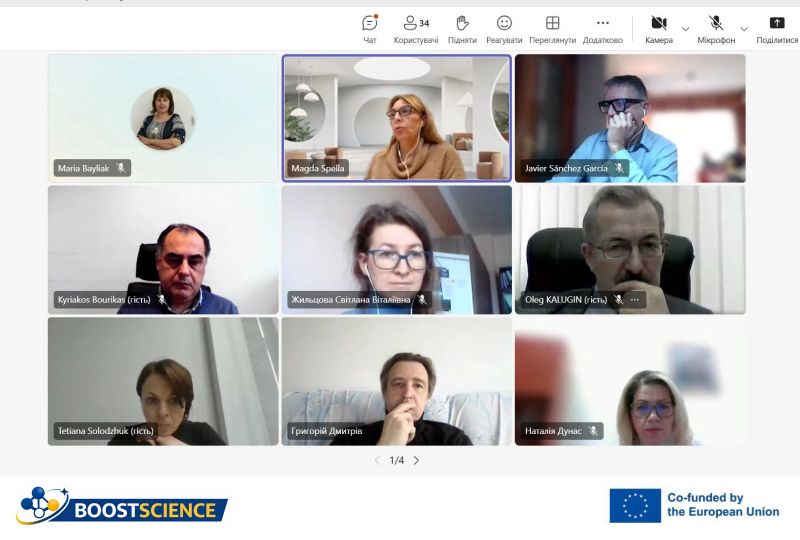
On 3 December 2025, the BOOSTSCIENCE consortium held its second online organisational meeting, marking continued progress in the implementation of the Erasmus+ Capacity Building in Higher Education (CBHE) project aimed at modernising Natural Sciences education in Ukraine.
The meeting focused on advancing key implementation activities and strengthening coordination across partner institutions.
Key Areas of Discussion
Needs Assessment Development
Consortium partners initiated the development of a structured questionnaire designed to identify the current educational needs of students, academic staff, and business stakeholders in the fields of Biology and Chemistry.
This needs assessment will inform curriculum modernisation efforts and ensure alignment between academic programmes and labour market expectations.
Dissemination and Project Coordination
Partners also coordinated dissemination and communication activities to enhance the project’s visibility and stakeholder engagement.
The meeting reinforced the use of Basecamp as the project’s collaborative management platform, supporting structured information sharing, task tracking, documentation management, and effective inter-partner communication.
Strengthening Strategic Alignment
Beyond operational coordination, the meeting provided an important forum for strategic discussion, knowledge exchange, and collective decision-making. Partners reviewed timelines, clarified responsibilities, and confirmed the next implementation milestones.
The consortium reaffirmed its shared commitment to delivering high-quality outputs and measurable impact in the modernisation of Higher Education in Ukraine.
BOOSTSCIENCE now proceeds into the next phase of intensive implementation, with a focus on concrete deliverables and stakeholder engagement.
Funding Acknowledgement
BOOSTSCIENCE is co-funded by the Erasmus+ Programme of the European Union.
The views and opinions expressed on this website are those of the authors and do not necessarily reflect those of the European Union or the European Education and Culture Executive Agency (EACEA). Neither the European Union nor the granting authority can be held responsible for them.