

What does it take to make science education more practical, more connected and more resilient? The first issue of the BOOSTSCIENCE newsletter brings together the people, ideas and early results behind that question.
From the project’s opening meeting in Athens to conversations about the skills Biology and Chemistry graduates need, this edition looks at the work taking shape across universities and organisations in Ukraine, Greece and Spain.

A collaboration that began in Athens
On 15 and 16 January 2026, the BOOSTSCIENCE consortium met in Athens for the project’s kick-off, hosted by the Hellenic Open University (HOU), which coordinates the initiative. Twelve partner organisations from Greece, Spain and Ukraine are working together over three years to support the modernisation of Natural Sciences higher education in Ukraine.
BOOSTSCIENCE focuses on a concrete challenge: helping students build a strong scientific foundation while giving them opportunities to practise research, use digital tools and connect their knowledge to professional and entrepreneurial settings. The project places particular emphasis on Biology and Chemistry, two disciplines where laboratory experience, data literacy and close contact with current research matter.
The collaboration brings together universities, research institutions and companies. Their different perspectives are important: a course can be academically rigorous and still benefit from the insight of the people who run laboratories, hire graduates, develop technologies or turn research into services and products.
Listening to the skills that students will need
One of the main stories in this newsletter is the BOOSTSCIENCE skills map for Biology and Chemistry education. The project engaged more than 300 stakeholders across Ukrainian and European ecosystems to identify areas in which students may need stronger preparation and more opportunities to apply what they learn.
Six competence areas emerged from that work. Together, they offer a useful picture of what well-rounded Natural Sciences education can look like:
The analysis is presented in D2.1, “Research and Entrepreneurial Skills Roadmap of Biology & Chemistry Ukrainian HEIs and Students.” It provides an evidence base for discussions about educational priorities; it is not a claim that every university or programme has the same needs. Those differences are precisely why collaboration with the institutions and their stakeholders matters.
Bringing universities, research and industry into the same conversation
In July 2026, BOOSTSCIENCE organised the workshop “Reshaping Ukrainian and European Universities.” More than 60 participants from universities, research institutions, businesses and innovation ecosystems in Greece, Spain and Ukraine joined the discussion.
There is no single way to strengthen the connection between higher education and professional life. Research groups, students, universities and employers encounter different constraints. The workshop created space to compare those experiences and examine how Chemistry, Biology and Biotechnology education can benefit from closer links between academic learning, research, entrepreneurship and industry.
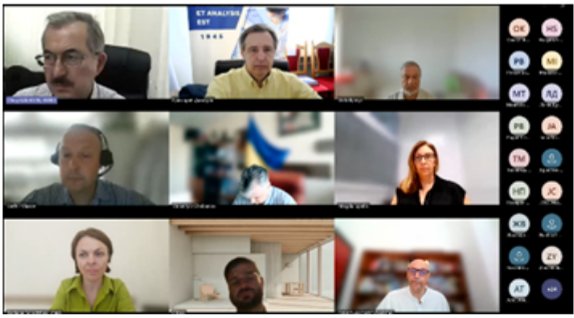
The conversations are part of the broader work to make educational reform grounded in the experience of the people who teach, study, research and employ Natural Sciences graduates. For universities, that means looking beyond the syllabus alone: how a subject is taught, what students can practise and how they receive feedback are all part of the learning experience.
From the skills map to a new Master’s-level syllabus
The newsletter also introduces a concrete educational output: D2.2, the BOOSTSCIENCE New Module Syllabus. It establishes the design of a new 5-ECTS course for Master’s-level students in Biology and Chemistry at Ukrainian higher education institutions.
The proposed syllabus comprises 15 thematic modules and an estimated 150 hours of learner workload. It draws on stakeholder and labour-market evidence and the European competence frameworks DigComp, ResearchComp, EntreComp and GreenComp.
At the heart of the course is a practice- and research-oriented approach. The project envisages digital and distance-learning opportunities, including virtual laboratory activities, alongside ways for students to strengthen their scientific reasoning and entrepreneurial competences. The syllabus sets out that direction; the newsletter does not claim that the course has already been delivered to students.
What makes this approach promising is not one technology or teaching method on its own. It is the opportunity to connect practical laboratory learning, careful research and transferable skills in a coherent programme that Ukrainian higher education institutions can adapt to their contexts.
A first edition worth keeping
These are the stories collected in the October 2026 edition. The original three-page design, shared with the consortium, brings together the project’s early achievements and the people behind them. We have kept the newsletter available online so that partners, students and interested organisations can return to it and share a single, accessible link.
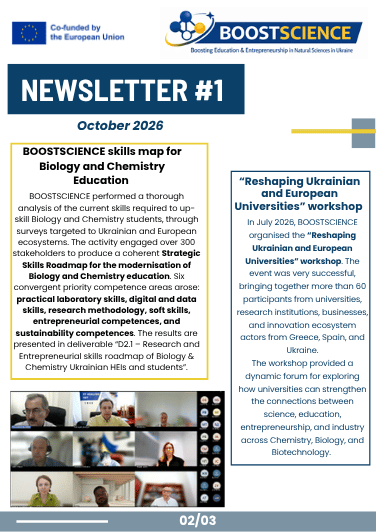
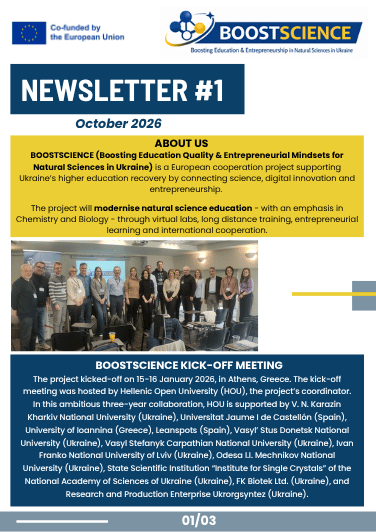
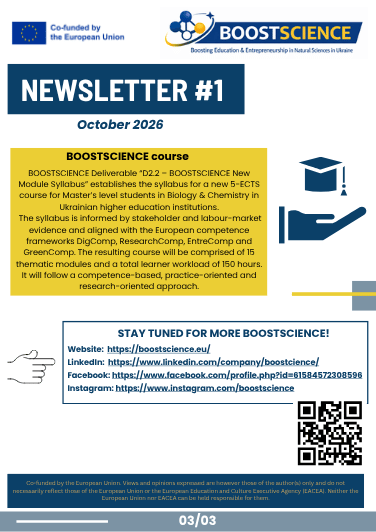
Original newsletter design: Magda Spella, BOOSTSCIENCE consortium.
Read BOOSTSCIENCE Newsletter #1 in full
Explore the October 2026 edition, with its original project photographs, workshop highlights and links.
We look forward to sharing further updates as the consortium continues its work with Ukrainian higher education institutions and their European partners. You can follow the project through boostscience.eu and its LinkedIn page.
BOOSTSCIENCE — Boosting Education Quality & Entrepreneurial Mindsets for Natural Sciences in Ukraine. Erasmus+ Capacity Building in Higher Education, Grant Agreement No. 101237769.
Co-funded by the European Union. Views and opinions expressed are, however, those of the author(s) only and do not necessarily reflect those of the European Union or the European Education and Culture Executive Agency (EACEA). Neither the European Union nor EACEA can be held responsible for them.